
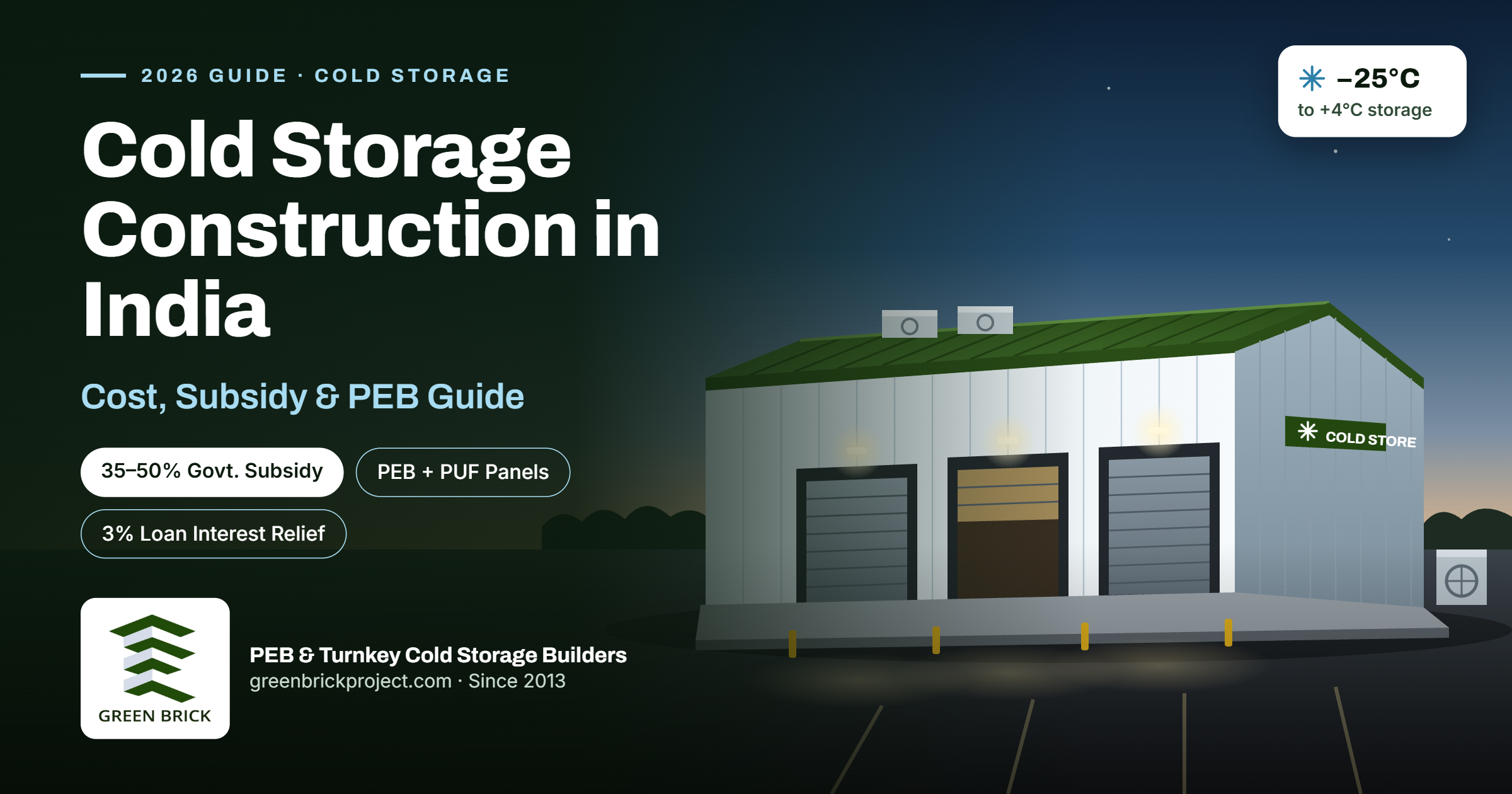
India grows huge quantities of fruits, vegetables, dairy and medicines that need to stay cold — but cold storage space has not kept up. That gap is now a business opportunity. With the government covering 35% to 50% of eligible project cost through subsidy, 2026 is one of the best times to build a cold storage.
This guide explains, in simple words, what a cold storage costs to build, which subsidies and loans you can claim, why most new cold stores are now built as Pre-Engineered Buildings (PEB), and the exact steps from idea to a running facility.
Green Brick Project has been designing and building PEB and turnkey industrial structures since 2013, from its manufacturing plant at Bagru, Jaipur, with project offices in Maharashtra, Madhya Pradesh, Uttar Pradesh and Haryana.
Why Cold Storage Demand Is Booming in 2026
The India cold storage market is estimated at about USD 10.2 billion in 2026 and projected to reach about USD 13.7 billion by 2031 (Mordor Intelligence). Four forces are driving it:
- Farm produce and post-harvest loss. Potatoes, onions, fruits and vegetables lose value fast without cold storage. Farmers, traders and FPOs want to store at harvest and sell when prices rise.
- Quick commerce and organised retail. Grocery apps and supermarkets need small, multi-temperature cold rooms close to cities, not only large rural stores.
- Pharma and vaccines. Medicines need strict 2–8°C storage, and pharma cold chain is expanding.
- Dairy, frozen food and food processing. Ice cream, frozen snacks, meat and seafood all need frozen (−18°C to −25°C) storage.
The wider warehousing market is strong too. Industrial and warehousing leasing in India’s top eight cities reached nearly 22 million sq ft in the first half of 2026, up 12% year-on-year (Colliers). And India’s PEB market, valued at about USD 2.3 billion in 2025, is forecast to reach USD 6.5 billion by 2034 (IMARC) — cold storage is one of the fastest-growing uses of PEB.
Types of Cold Storage You Can Build
Pick the type by what you will store and at what temperature. This decides insulation thickness, machinery and cost.
| Type | Typical temperature | Best for |
|---|---|---|
| Bulk / single-commodity store | +2°C to +4°C | Potatoes, onions, seeds — large rural stores near farms |
| Multi-commodity store | 0°C to +10°C, separate chambers | Fruits, vegetables, spices, dry fruits for traders and FPOs |
| Frozen store | −18°C to −25°C | Ice cream, frozen food, meat, seafood |
| Controlled-atmosphere (CA) store | Near 0°C with controlled oxygen/CO₂ | Apples, pears and long-life fruit storage |
| Ripening chamber | +14°C to +20°C with ethylene | Bananas, mangoes, papaya (see our Ripening Chambers) |
| Pharma cold room | +2°C to +8°C, tightly monitored | Vaccines, medicines, lab materials |
| Multi-temperature warehouse | Several zones in one building | Quick commerce, retail distribution, 3PL |
PEB vs RCC Cold Storage: Which Is Better?
For most new cold storages, a PEB steel structure with PUF (polyurethane foam) insulated panels is faster and more economical than a conventional RCC (concrete) building. Industry estimates put PEB cold stores at roughly 20–30% lower cost and 40–60% faster to build than RCC (AgriJob). Faster completion matters: you start earning rent earlier and can catch the next harvest season.
| Factor | PEB + PUF panel cold storage | RCC (conventional) cold storage |
|---|---|---|
| Construction time | Weeks to a few months | Many months |
| Insulation | Factory-made PUF panels, fewer gaps | Insulation fixed on site, more joints |
| Clear span inside | Large column-free spans for racking | More columns, less usable space |
| Expansion | Add chambers or bays easily | Difficult and slow |
| Quality control | Made in factory, bolted on site | Depends on site workmanship |
| Subsidy | Eligible — MIDH/NHB norms include PEB construction | Eligible |
Compare PEB and conventional buildings in more detail in our guide: PEB vs Conventional Building.
Cold Storage Construction Cost in India 2026
In 2026, a turnkey cold storage in India costs about ₹3,000 to ₹7,000 per sq ft, excluding land. The range depends mainly on the grade of facility:
| Grade | Approx. cost (per sq ft) |
|---|---|
| Grade A cold storage | ₹5,000 – ₹7,000 |
| Grade B cold storage | ₹3,000 – ₹5,000 |
Cold stores are also often costed per tonne (MT) of storage capacity, because subsidy is calculated that way.
What changes your cost the most:
- Temperature. A frozen store (−20°C) needs thicker panels and bigger machinery than a chilled store (+2°C).
- PUF panel thickness. Thicker panels cost more upfront but cut electricity bills every month.
- Capacity and number of chambers. More chambers give flexibility but add doors, partitions and controls.
- Refrigeration system. Ammonia, Freon/HFC or newer low-impact refrigerants each carry different costs.
- Floor. Cold store floors need insulation and under-floor heating (for frozen stores) to stop frost heave, plus a hard, dust-free top surface for forklifts.
- Site and soil. Sand filling, foundations and approach roads vary from site to site.
- Power backup. A power cut can spoil a full store, so a DG set or battery backup is a must.
- Automation. Racking, temperature monitoring, remote alarms and docks with dock levellers.
Get an exact figure for your site: every cold store is different. Share your product, capacity and location with Green Brick and we will prepare a free layout and cost estimate — Get a Quote here. See also our PEB Construction Cost Per Sq Ft guide.
Cold Storage Subsidy 2026: NHB, MIDH, AIF and PMKSY
The government can pay 35% of eligible project cost in general areas and 50% in North-East, hilly and scheduled areas. You can also get a 3% cheaper loan. Here are the four main schemes:
| Scheme | Who runs it | Support | Key point |
|---|---|---|---|
| MIDH / NHM cold storage subsidy | State Horticulture Department | 35% (general) / 50% (NE, hilly, scheduled areas), back-ended | For horticulture cold storage up to 5,000 MT |
| NHB Capital Investment Subsidy | National Horticulture Board | 35% / 50% of capital cost, credit-linked | For larger cold stores above 5,000 MT up to 10,000 MT, plus modernisation |
| Agriculture Infrastructure Fund (AIF) | Banks, Ministry of Agriculture | 3% interest subvention on loans up to ₹2 crore for 7 years, plus credit guarantee | Can be combined with the MIDH/NHB subsidy |
| PMKSY Integrated Cold Chain | Ministry of Food Processing Industries | 35% / 50% grant, up to ₹10 crore per project | Only for integrated cold chain projects — standalone cold storage is not covered |
Important points before you apply:
- “Credit-linked back-ended” means the subsidy is released after the project is complete, and only if you have taken a bank term loan for it.
- Get your bank loan sanctioned before starting construction. Starting work early can make the project ineligible.
- Subsidy is calculated on the government’s cost norms per MT, not on your actual bill. Ask your State Horticulture Department or NHB office for the current norms.
- Scheme rules change. Always confirm the latest guidelines on the official NHB website before applying.
- Rajasthan investors can also check incentives under the Rajasthan Investment Promotion Scheme (RIPS) 2024.
How to Build a Cold Storage: Step by Step
- Study demand. Talk to local farmers, traders and food companies. Know what they will store, how much, and for how long.
- Choose the site. Good road access, reliable 3-phase power, water, and land that does not flood.
- Fix capacity and temperature. Decide MT capacity, number of chambers and temperature range for each chamber.
- Get a layout and estimate from your EPC contractor. Green Brick prepares the building design, PUF panel specification and cost estimate.
- Prepare the Detailed Project Report (DPR). Banks and subsidy offices check this closely.
- Get the bank loan sanctioned and apply for subsidy. Apply under MIDH/NHB and AIF as eligible.
- Approvals. Land use, building plan, power connection, pollution and fire clearances as required by your state.
- Construction. Foundations and insulated floor, PEB structure erection, PUF panels, doors, docks.
- Refrigeration and electricals. Compressors, cooling units, controls, power backup and monitoring.
- Testing and handover. Temperature pull-down test, then start operations and claim the subsidy release.
- Maintain it. Regular checks keep panels sealed and floors crack-free. See Preventive Maintenance for PEB buildings.
7 Costly Mistakes to Avoid
- Building too big too early. Build for confirmed demand and plan a layout that can expand later.
- Starting construction before loan sanction. This can cost you the entire subsidy.
- Choosing thin insulation to save money. You pay it back many times over in electricity.
- Ignoring the floor. Frozen stores without proper floor insulation and heating can crack and heave.
- No power backup. One long power cut can spoil a full store of produce.
- Splitting the work between many vendors. Gaps between the civil, structure, panel and refrigeration teams cause delays and leaks. A single turnkey contractor is safer.
- Skipping maintenance. Damaged panel joints and door seals let heat in and raise costs.
Why Build Your Cold Storage with Green Brick Project
- Since 2013: 135+ projects completed, covering 8.95+ million sq ft.
- Own manufacturing: 15,000+ MT production capacity at our Bagru plant, Jaipur — steel is made in our own factory, not outsourced.
- Turnkey EPC: design, PEB structure, civil work and project management under one contract.
- Pan-India reach: project offices in Maharashtra, Madhya Pradesh, Uttar Pradesh and Haryana.
- ISO 9001, ISO 14001 and ISO 45001 certified.
- After-handover care: our I-Care Preventive Maintenance Program keeps your building, roof and floors in top condition.
Explore our Cold Storages, Turnkey Services and completed PEB projects.
Planning a cold storage? Get a free estimate
Tell us what you want to store, the capacity and your location. Our team will share a layout and cost estimate.
Call / WhatsApp: +91 9829898720 · Email: sale@greenbrickproject.com
Get a Free QuoteFrequently Asked Questions
What is the cost of cold storage construction in India in 2026?
A turnkey cold storage costs about ₹5,000 to ₹7,000 per sq ft for Grade A and ₹3,000 to ₹5,000 per sq ft for Grade B, excluding land. The final cost depends on temperature, capacity, insulation and machinery. Get a site-specific quote from Green Brick.
How much subsidy is available for cold storage?
Under MIDH and NHB, the subsidy is 35% of eligible project cost in general areas and 50% in North-East, hilly and scheduled areas. It is credit-linked and released after completion.
Can I get a cheaper loan for cold storage?
Yes. Under the Agriculture Infrastructure Fund, loans up to ₹2 crore get 3% interest subvention for up to 7 years, along with credit guarantee cover.
Is a PEB cold storage eligible for subsidy?
Yes. Government cost norms include cold storages built as pre-engineered buildings with insulated panels.
How long does it take to build a cold storage?
A PEB cold storage is usually much faster than an RCC one, because the steel and panels are made in a factory while site work goes on. The exact time depends on size and approvals.
Which is better for cold storage, PEB or RCC?
For most projects PEB with PUF panels is better: faster to build, column-free inside, easy to expand, and with fewer insulation gaps.
Does Green Brick build cold storages outside Rajasthan?
Yes. Green Brick works across India, with project offices in Maharashtra, Madhya Pradesh, Uttar Pradesh and Haryana.
