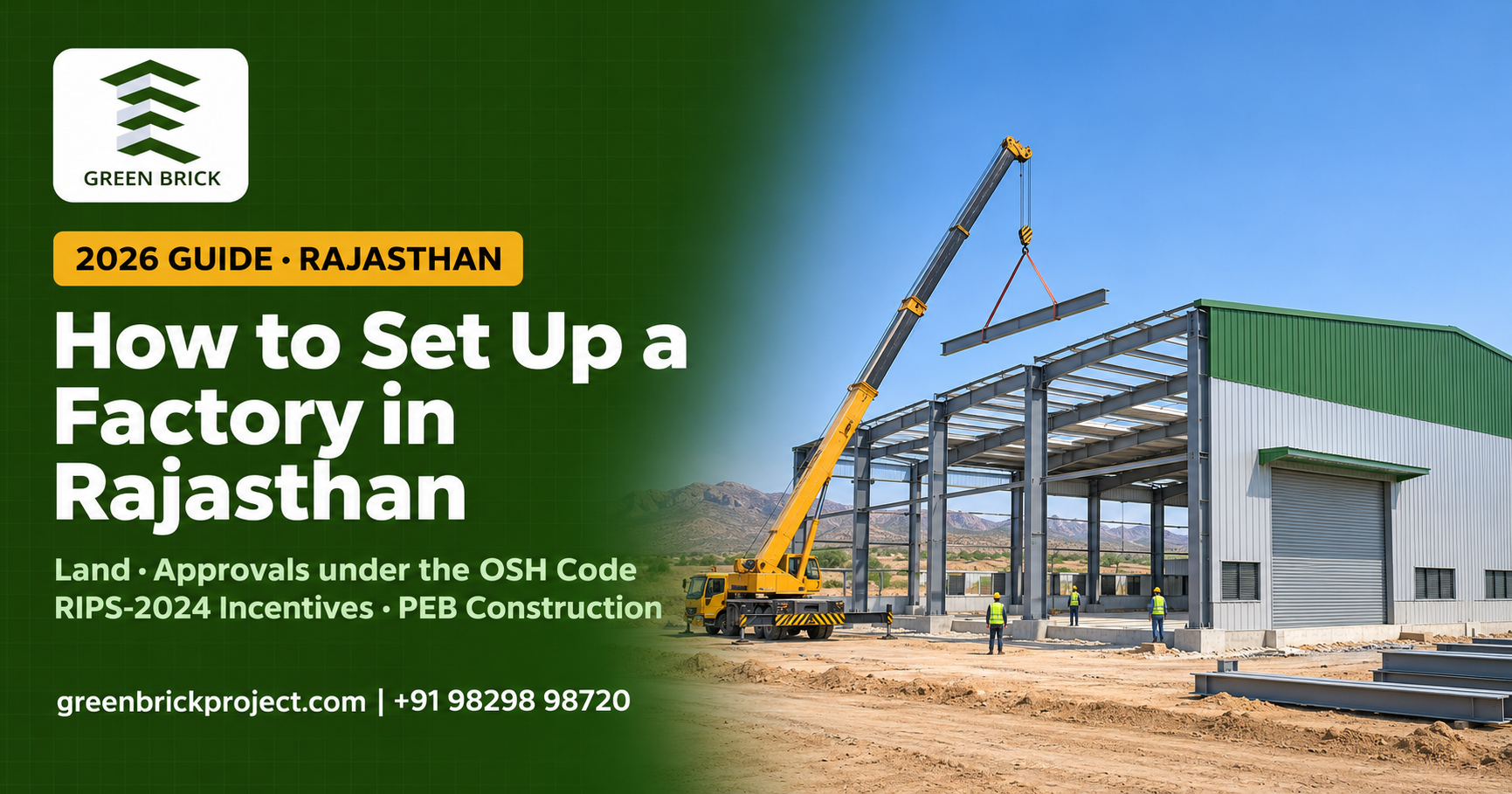
Most factory projects in Rajasthan don’t run late because of the steel. They run late because things happen in the wrong order. Land gets bought before the building size is known, the structure gets designed before the pollution category is checked, or building work starts before the factory plan is approved.
The rules also changed recently. The Occupational Safety, Health and Working Conditions (OSH) Code, 2020 replaced the Factories Act on 21 November 2025, and Rajasthan notified its own OSH Rules on 30 June 2026. The state’s main incentive scheme, RIPS-2024, runs until March 2029. Many factory setup guides online still describe the old system.
This guide gives you the 2026 order of steps for setting up a factory in Rajasthan. It covers what to decide first, which approvals come when, how to use the incentives, and how to plan the building so it’s ready on time.
Planning a factory in Rajasthan?
Send us your plot size, product and timeline. Our Jaipur team will tell you what building suits your process and what to sort out before you buy land.
What changed for factory setup in Rajasthan in 2025–26
If you read a guide written before late 2025, check these five points first. Each one changes how you plan.
| Topic | Earlier position | Position in 2026 |
|---|---|---|
| Main safety law | Factories Act, 1948 and Rajasthan Factories Rules, 1951 | OSH Code, 2020 (in force from 21 Nov 2025) and Rajasthan OSH Rules, 2026 (notified 30 Jun 2026) |
| When a unit counts as a “factory” | 10+ workers with power, or 20+ without | 20+ workers with power, or 40+ without |
| Factory plan approval | Under Rule 3A of the 1951 Rules | Prior written permission from the Chief Inspector-cum-Facilitator, applied for on Form-6 through the official portal |
| MSME self-declaration exemption | 3 years from the acknowledgement certificate | Increased to 5 years by a 2023 amendment to the Rajasthan MSME Act, 2019 |
| State incentive scheme | RIPS-2022 | RIPS-2024, notified 8 Oct 2024 and running until March 2029 |
Labour codes are still being rolled out. Licences and processes that already exist continue during the transition. Before you file anything, confirm the current procedure with the Rajasthan Factories & Boilers Department or a compliance consultant.
Step 1: Define the project before you look at land
The building, the approvals and even the right plot all depend on a few early decisions. Get these written down before you talk to any land seller or contractor:
| Decide this | Why it matters |
|---|---|
| Product and process flow | Sets the building length, the bay layout and where loading docks go |
| Machine list and heaviest load | Sets the foundations, the floor slab thickness and the column spacing |
| EOT crane (capacity, span, hook height) | The biggest factor in steel weight and eave height |
| Pollution category | Decides which consents you need, and whether a particular industrial area or plot is allowed at all |
| Peak headcount, including contract workers | Decides whether the OSH Code “factory” threshold applies, and how many toilets, exits and amenity areas you need |
| Expansion in 3–5 years | Decides where to leave free land and how to design an end wall that can be extended |
One page with these answers will make every quotation you receive comparable. Without it, contractors each make their own assumptions and quote different buildings.
Step 2: Choose land: RIICO plot or private land
Most new factories in Rajasthan are built either in a RIICO industrial area or on private land converted to industrial use. RIICO allots plots through direct allotment and e-auctions, and its online portal handles applications and payments.
| Factor | RIICO industrial plot | Converted private land |
|---|---|---|
| Land use | Already industrial | Needs conversion. RIPS-2024 gives MSMEs relief on conversion charges |
| Building rules | RIICO Building Regulations (setbacks, ground coverage, FAR) | Rules of the local body or development authority |
| Road, power and water | Usually provided at estate level | You may need to arrange them yourself |
| Plan approval | Smaller plots can use a self-certified route (see below) | Local authority approval process |
| Bank finance | Allotment letter is accepted by lenders, including state finance schemes | Title and conversion papers need closer checks |
Building plans on RIICO plots
Under the RIICO Building Regulations 2021, an industrial plot of up to 40,000 sq m with less than 10,000 sq m of construction can be built on as per the regulations without RIICO approving the building plan first. Larger plots or larger buildings need RIICO approval before construction starts. Confirm the current version of the rules with the RIICO unit office for your area.
Rajasthan site conditions to brief your designer on
- Heat: a roof without insulation makes summer working conditions much harder. Decide on roof insulation and ventilation at the design stage, not afterwards.
- Wind and dust: the design wind speed depends on the location (IS 875 Part 3). Dust storms also mean ridge vents, louvres and wall joints need proper sealing.
- Soil: sandy and filled soils are common. Get a soil investigation done before the foundation design. It’s the cheapest risk check in the whole project.
Step 3: Approvals for setting up a factory in Rajasthan, in the right order
The common mistake is to treat approvals as paperwork you finish after the building is up. Several of them must be in place before construction starts.
| Approval | Authority / portal | When |
|---|---|---|
| Udyam registration and GST | Udyam portal, GST portal | At the start |
| MSME declaration of intent | Raj Udyog Mitra portal (Bureau of Investment Promotion) | Before you begin operations |
| RIPS-2024 incentive application | Rajasthan single window portal (RajNivesh) | Early, as advised by the department |
| Consent to Establish (CTE) | Rajasthan State Pollution Control Board | Before construction (Red, Orange and Green categories) |
| Building plan clearance | RIICO or the local body | Before construction |
| Fire NOC / fire scheme | LSG Department, in urban areas | At design stage. In municipal areas it is needed before building plan approval |
| Factory plan approval (Form-6) | Chief Inspector-cum-Facilitator, Rajasthan OSH Rules | Before construction, if the unit will be a “factory” |
| Power connection | Your electricity distribution company | Apply during construction |
| Consent to Operate (CTO) | Rajasthan State Pollution Control Board | Before production |
| Factory licence (Form-5) | Official portal, Rajasthan OSH Rules | Before production. Can be issued for up to 10 years |
How the MSME self-declaration helps, and where it doesn’t
Under the Rajasthan MSME (Facilitation of Establishment and Operation) Act, 2019, a new MSME files a declaration of intent and receives an acknowledgement certificate. This exempts it from approvals and inspections under State laws for a set period. A 2023 amendment raised that period from three years to five. After it ends, the unit must get the required approvals within six months.
Two limits are worth knowing. The certificate does not let you use land for a purpose that isn’t permitted. And obligations under central laws, such as pollution consents under the Water and Air Acts, need separate checking. Treat the exemption as a way to start faster, not as a reason to skip compliance. Your building and fire design should be ready for the approvals you’ll need later.
Step 4: Use RIPS-2024 incentives properly
RIPS-2024 covers manufacturing and service MSMEs. Trading units are not covered. The MSME size limits used in the scheme are:
| Class | Investment | Turnover |
|---|---|---|
| Micro | Up to ₹1 crore | Up to ₹5 crore |
| Small | Up to ₹10 crore | Up to ₹50 crore |
| Medium | Up to ₹50 crore | Up to ₹250 crore |
The MSME benefits most relevant to a new factory include:
- Stamp duty and land conversion charges: 100% benefit, released in stages as notified by the State.
- Electricity duty: 100% exemption for 7 years.
- Mandi fee: 100% reimbursement for 7 years, where it applies.
- Sector-specific capital subsidies, for example for agro and food processing units.
- Overall cap: all MSME incentives together are capped at ₹5 crore a year.
Production has to start within the scheme period, or within two years of the entitlement certificate, whichever is later. That deadline is a good reason to choose a fast construction method.
Whether your building’s cost counts as “Eligible Fixed Capital Investment” is defined in the scheme’s annexures. Confirm this with the Industries Department before you finalise your project report. Keep every construction invoice, BOQ and measurement record organised from day one, because the claim depends on them.
Need a building estimate for your project report or bank file?
We prepare design-based estimates with BOQs for PEB factory buildings, turnkey or structure-only, so your DPR, loan file and incentive claim all use the same numbers.
Step 5: Design the factory building
For most manufacturing units, the main shed is a pre-engineered building (PEB). The steel frame is designed for your loads, made in a factory and bolted together on site, so fabrication can happen while the foundations are being built. That overlap is why PEB suits projects working to an incentive or production deadline. For a full comparison, read our guide on PEB vs conventional buildings.
Design inputs your PEB designer needs
- Clear span, building length and bay spacing, worked out from the machine layout
- Eave height and clear height under the crane hook
- Crane details: capacity, number of cranes, span and duty class
- Mezzanines, pipe racks or roof-mounted equipment, including any rooftop solar
- Roof and wall sheeting, and the type and thickness of insulation
- Skylights, ridge ventilators, louvres and wall openings
- Which end wall will be extended later
Factory buildings for Rajasthan’s climate
In Rajasthan, the roof is the main source of heat in the building. Insulated roof sheeting or sandwich panels, good natural ventilation and well-placed daylight panels make the shed more comfortable to work in and reduce cooling costs. Plan these in the first design. Adding them later costs much more.
Depending on your process, the same site may also need a warehouse, an office block, or a separate industrial shed for utilities. Designing them together keeps the structure and drainage consistent and makes approvals simpler.
Step 6: Budget the complete build, not just the shed
Factory budgets go wrong when the “per sq ft” rate covers only part of the work. Before you compare quotes, check that every line below is either included or budgeted separately:
| Budget item | Often missed? |
|---|---|
| Soil investigation and site survey | Yes |
| Site levelling, filling and compaction | Yes, especially on low-lying plots |
| Foundations, pedestals and anchor bolts | Sometimes left out of “structure-only” quotes |
| PEB structure (primary and secondary steel) | No |
| Roof and wall sheeting, insulation, flashings, gutters | Insulation is often quoted separately |
| Industrial floor (thickness, finish, joints) | Yes |
| Crane runway beams and crane | Runway is often excluded |
| Electrical, plumbing, drainage, fire systems | Yes |
| Boundary wall, roads, gate, security cabin | Yes |
| Design, approvals, consultants, GST | Yes |
For current per-square-foot ranges and how GST applies, see our PEB construction cost per sq ft guide. If your project is mainly storage, the PEB warehouse cost guide is more relevant. A turnkey contract, where one party is responsible for civil work, structure and finishes, avoids most of these gaps.
Step 7: Build in the right sequence and avoid delays
A typical sequence for the building:
- Survey and soil test, then freeze the design and issue the anchor bolt plan.
- Civil works: excavation, footings, pedestals and anchor bolts, set to the PEB supplier’s drawings.
- Fabrication of the PEB members at the plant, running at the same time as the civil works.
- Erection of columns, rafters, bracing and purlins, followed by roof and wall sheeting.
- Industrial floor, drainage and utilities inside the closed building.
- Fire systems, electrical work and commissioning, then handover.
Where delays usually come from:
- Approval drawings and construction drawings that don’t match, so the plans have to be resubmitted.
- Anchor bolts set with the wrong levels or positions, which stops erection.
- The floor being cast before the heavy machine foundations are finalised.
- Separate civil and steel contractors blaming each other for interface problems.
Our step-by-step article on how to build a PEB factory from land to handover covers the construction stages in more detail. Keep your site team safe throughout with our construction site HSE checklist.
Step 8: Licence, commissioning and maintenance
Before production starts, you’ll need the Consent to Operate, the factory licence (if your unit counts as a factory), the power connection and your fire compliance documents. Keep as-built drawings, structural design calculations and material test certificates in one folder. Inspectors, insurers and lenders will ask for them.
A PEB factory lasts longest when it is maintained from the first year. That means checking roof fasteners, cleaning gutters, inspecting coatings, re-tightening bolts and checking crane rails. Green Brick’s I-Care preventive maintenance programme covers this on an annual plan, and our preventive maintenance guide explains what to inspect and how often.
Before you sign a factory construction contractor
- Is the scope written line by line, showing exactly what is included and excluded?
- Does the design follow your crane, mezzanine and expansion requirements?
- Will you receive the design basis, GA drawings and an anchor bolt plan before civil work starts?
- Is the steel grade, coating system and sheeting specification named?
- Who is responsible for civil work, and who is responsible if the two packages don’t fit together?
- Does the payment schedule follow measurable milestones?
- Does the contractor have its own fabrication capacity, or does it subcontract?
- Can you visit a completed project and speak to that client?
- Does the contractor offer maintenance support after handover?
- Will the BOQ and invoices be in a format that supports your bank and RIPS-2024 documents?
How Green Brick helps factory owners in Rajasthan
Green Brick Project Private Limited is a Jaipur-based EPC, PEB and turnkey industrial construction company, working since 2013. We design, manufacture and build factory buildings from our Bagru manufacturing plant (Solitaire Industrial Park, Ajmer Road), which has an annual production capacity of over 15,000 MT.
- 2013Working since
- 140+Projects completed
- 8.95 mnSq ft covered
- 15,000+ MTAnnual capacity
We hold ISO 9001:2015, ISO 14001:2015 and ISO 45001:2018 certifications (see certificates). Our Rajasthan projects include work for QSWPL at Phagi, RMS Stonex at Kishangarh, Mayur Uniquoters at Dhodhsar and SGB Infra at Mohangarh, Jaisalmer. You can see more on our PEB projects page.
We can take on the full project, including design, factory building supply and erection, and civil construction. We can also act as your project management consultant.
Get a factory building estimate
Fill in these details and the form will open WhatsApp with your message ready to send. You can also email sale@greenbrickproject.com.
Frequently asked questions
Do I need factory plan approval before construction in Rajasthan?
Yes, if your unit will count as a “factory” under the OSH Code. That means 20 or more workers where power is used, or 40 or more without power. Under the Rajasthan OSH Rules, 2026, you need prior written permission from the Chief Inspector-cum-Facilitator to build, extend or use a building as a factory. You apply on Form-6 through the official portal. Confirm the current process before you file.
Can an MSME start a factory in Rajasthan without approvals?
A new MSME can file a declaration of intent on the Raj Udyog Mitra portal. With the acknowledgement certificate, it is exempt from approvals and inspections under State laws for the exemption period, which is now five years. It does not cover land-use violations, and obligations under central laws need separate checking. The unit must get its approvals within six months after the period ends.
What incentives does RIPS-2024 give a new MSME factory?
The benefits include 100% relief on stamp duty and land conversion charges (released in stages), 100% electricity duty exemption for 7 years, mandi fee reimbursement and some sector-specific capital subsidies. All MSME incentives together are capped at ₹5 crore a year. Check eligibility and the current procedure with the Industries Department.
Which is better for a factory in Rajasthan: PEB or RCC?
For large-span production sheds, warehouses and buildings with cranes, PEB is usually faster to build and easier to extend later. RCC is still common for multi-storey office blocks and some process areas. Many factories use both: a PEB shed with an RCC or PEB office block. Our PEB vs conventional comparison explains the trade-offs.
Do I need RIICO approval for my building plan?
Under the RIICO Building Regulations 2021, industrial plots of up to 40,000 sq m with less than 10,000 sq m of construction can be built on as per the regulations without RIICO approving the plan first. Larger projects need approval before construction. Your plans must still follow setback, coverage and height norms. Confirm with the RIICO unit office for your area.
How early should I involve the PEB contractor?
Before you finalise the plot, or at least before the building plan is drawn. The contractor’s design decides column positions, foundation loads and building height, and these feed into your approval drawings and civil work. Involving them early avoids having to redraw and resubmit plans.
The bottom line
Setting up a factory in Rajasthan in 2026 is easier than it was a few years ago. The MSME exemption is longer, RIPS-2024 offers real incentives and the OSH Code has raised the threshold for when a unit counts as a factory. But the order of steps still matters. Fix your process and pollution category first, choose land that suits them, get the pre-construction approvals in place, and let the building design run alongside the approvals.
Ready to plan your factory building?
Share your plot details and process. We’ll suggest a building layout, outline the specification and give you a design-based estimate.
References
This guide is general information, not legal or tax advice. Policies change, so confirm details with the relevant department or a qualified consultant before you act.
- Taxmann: Govt notifies 21 Nov 2025 for enforcement of the OSH Code, 2020
- Lakshmikumaran & Sridharan: Rajasthan OSH Rules, 2026 (S.O.23, 30 Jun 2026)
- IMPRI: OSH Code factory thresholds (20 / 40 workers)
- India Code: Rajasthan MSME (Facilitation of Establishment and Operation) Act, 2019, and the 2023 amendment
- Raj Udyog Mitra portal
- Rajasthan Investment Promotion Scheme 2024 (notified 8 Oct 2024), copy hosted by EPCH
- RIICO Building Regulations 2021, building plan approval provisions (reference copy)
- Down To Earth: RSPCB industry categories and consent validity