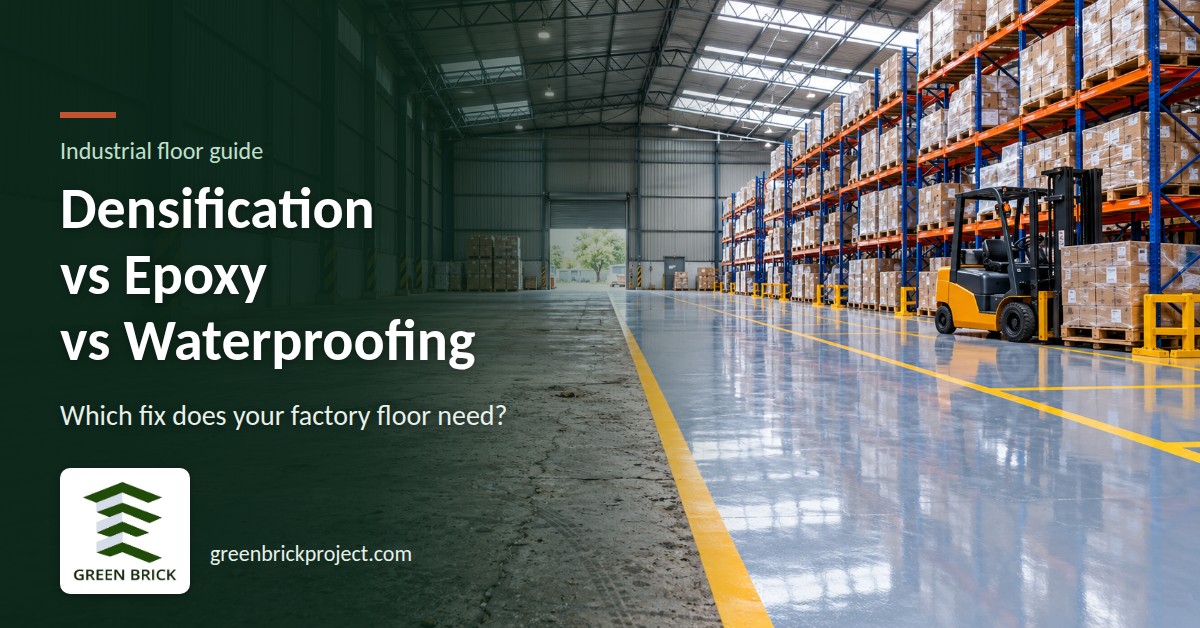
Forklifts, pallet trucks, heavy racks, chemicals and water all hit your floor every single day. Yet the floor is usually the last thing anyone checks.
A weak or damaged floor quietly costs money. Dust settles on products, forklift wheels wear out faster, and small cracks slowly turn into big repairs. This guide explains the common industrial floor problems and the right fix for each, in simple words.
5 warning signs your industrial floor needs attention
1. Dusting: a fine grey powder keeps coming back, even after sweeping.
2. Cracks: thin lines or wide gaps, often near joints, columns or loading areas.
3. Surface wear: rough patches, pitting or broken edges where forklifts turn.
4. Seepage or damp patches: water coming up from below or entering from walls and joints, especially in monsoon.
5. Stains that won’t clean: oil, chemical or food spills soaking into bare concrete.
If you see even one of these, it is cheaper to act now than after the damage spreads.
Floor densification: harden the concrete you already have
Densification is a treatment where a liquid hardener is applied to the concrete floor. It soaks into the surface and reacts with the concrete, making the top layer harder and less porous.
The result is a floor that stops dusting, resists wear better and is easier to clean. It keeps the natural concrete look and can be polished for a light sheen.
Best for: warehouses, logistics centres and factories with forklift traffic, where the main problem is dust and wear.
Epoxy flooring: a tough, seamless coating
Epoxy is a resin coating laid over the concrete. It forms a smooth, seamless layer that seals the surface completely.
Because nothing soaks through, epoxy floors resist oil, chemicals and stains, and are very easy to clean. They also come in colours, so you can mark walkways, machine zones and safety lines.
Best for: pharma, food processing, electronics, clean rooms, workshops and any area where hygiene or chemical spills matter.
Waterproofing and crack repair: stop the damage at the source
Cracks and seepage are not just surface problems. Water that enters through a crack can weaken the concrete below and damage stored goods.
Crack repair fills and seals the cracks with the right material, so they stop spreading. Waterproofing blocks water coming from below or from joints and walls.
Best for: older floors, floors near loading docks, basements, cold storages and any building that shows damp patches in monsoon.
Which fix does your floor need?
Most floors need one main treatment, and some need two together. Use this table as a starting point, then get the floor checked on site.
| Your main problem | Best fit | Why |
|---|---|---|
| Dust and surface wear from forklifts | Densification | Hardens the top layer and stops dusting |
| Oil, chemical or food spills | Epoxy | Seals the surface so nothing soaks in |
| Need colour-coded zones or a very clean look | Epoxy | Smooth, coloured finish that is easy to clean |
| Cracks that keep spreading | Crack repair, then densification or epoxy | Fix the damage first, then protect the surface |
| Damp patches or water seepage | Waterproofing | Stops water before it weakens the concrete |
| Old floor with several problems | A combined plan after inspection | One visit, one plan, the right order of work |
Regular care costs less than emergency repair
Most floor damage starts small. A hairline crack or a little dust is easy to fix, but ignored for a season, it can mean stopping work for a major repair.
That is why Green Brick runs I-Care, our Preventive Maintenance Program. Under I-Care, our team:
1. Inspects your building regularly
2. Gives you a clear report of the current condition
3. Plans repairs by priority, so urgent issues come first
4. Carries out the work with minimal disruption to your operations
5. Keeps monitoring, so new problems are caught early
I-Care is available as a membership, and it covers buildings built by any contractor, not only Green Brick. Our floor services, including densification, epoxy, waterproofing and crack repair, fit right into your maintenance plan.
Why factory owners trust Green Brick
Since 2013, Green Brick Project has designed, manufactured and built pre-engineered buildings, industrial sheds and warehouses in Jaipur and across India. Our work covers both steel structures and civil construction.
✓ ISO 9001, ISO 14001 and ISO 45001 certified
✓ Our own manufacturing plant at Solitaire Industrial Park, Ajmer Road, Bagru
✓ Head office in Bani Park, Jaipur, with regional offices in Maharashtra, Madhya Pradesh, Uttar Pradesh and Haryana
✓ Civil construction and turnkey services under one roof
✓ Projects for companies such as Mayur Uniquoters, KM Trans Logistics, Evershine Marbles and Bajaj Surfactants
Ask for a floor inspection for your factory or warehouse
Tell us your location, floor area and the problem you see, and our team will get back to you.
Get a quote online
Call +91 9829898720
Email us
Frequently asked questions
What is the difference between densification and epoxy?
Densification hardens the concrete itself and keeps its natural look. Epoxy adds a sealed coating on top, which is better against chemicals and stains. Can you treat a floor without stopping my operations?
It depends on the floor and the treatment. Talk to our team about your working hours before any work is scheduled. Do I need to repair cracks before applying epoxy?
Yes. Coating over open cracks hides the problem for a short time only. Cracks should be repaired first. Do you work on buildings that Green Brick did not build?
Yes. Our floor services and I-Care maintenance are open to any industrial building. Do you work outside Jaipur?
Yes. We have regional offices in several states. Share your location and we will confirm.