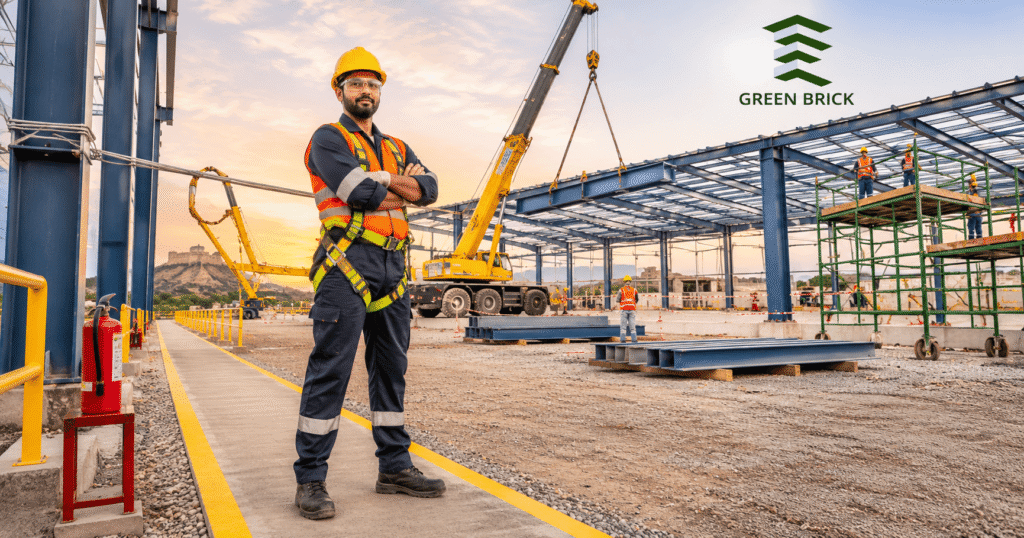
Quick answer: Construction site safety in India comes down to 12 areas: PPE, working at height, ladders, scaffolding, cranes, welding, gas cylinders, electrical work, vehicles, fire extinguishers, first aid and housekeeping. Get these 12 right and you control most of the hazards that cause serious injuries on Indian sites.
At Green Brick Project Pvt. Ltd., we have built industrial sheds, warehouses and pre-engineered buildings (PEB) since 2013, covering more than 8.95 million sq ft across 140+ projects. This guide is the same set of HSE dos and don’ts we use on our own sites, written for site engineers, contractors, supervisors and factory owners. Planning a new building? Get a free quote from our team.
Key safety numbers at a glance
- Full body harness with double lanyard for any work above 1.8 m
- Ladder angle at 4:1 (4 units up for every 1 unit out at the base)
- Scaffold guardrails: top rail 1 m, mid-rail 450 mm, toe board 150 mm
- Cranes stay at least 4.5 m from overhead power lines above 5 kV
- Fire extinguisher (6 kg CO₂ or DCP) within 8 m of every hot work spot
- 30 mA ELCB on every temporary electrical circuit
- O₂ and fuel gas cylinders stored at least 20 ft apart
12 HSE dos and don’ts for construction sites
1. Personal protective equipment (PPE)
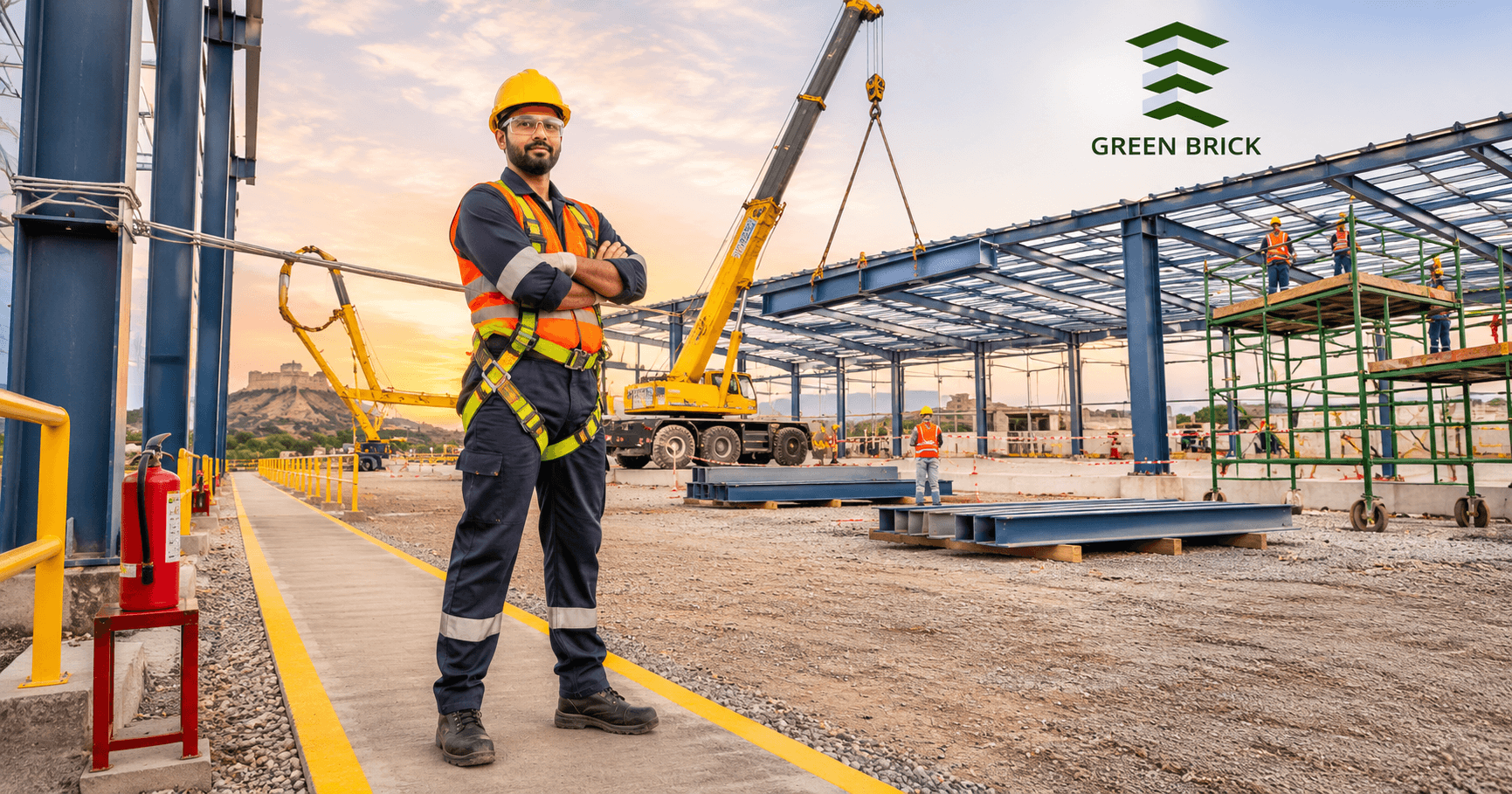
Every person on site must wear a hard hat, hi-vis vest and steel-toed safety boots at all times. PPE is a legal requirement, not a choice.
Wear leather gloves when handling material, safety glasses or a face shield for grinding and welding, and ear muffs in high-noise zones.
Enter any area in sandals or bare feet, or wear synthetic clothing near welding. Synthetic fabric melts onto skin.
2. Working at height: harness and fall arrest
Any work above 1.8 m needs a full body harness with a double lanyard, so the worker stays tied off 100% of the time.
Anchor to a certified lifeline rated to at least 2,300 kg, inspect the harness before every use, and wear a life jacket when working over water.
Use a single lanyard, anchor to a scaffold tube, replace a harness with ordinary rope, or keep using a harness past its rated service life or after it has arrested a fall.
3. Ladders
Set every ladder at a 4:1 ratio: for every 4 m of height, the base sits 1 m out from the wall.
Prefer steel ladders, keep a helper at the base when the top is not tied, and keep 3-point contact while climbing. Limit ladder length to 9 m with rungs no more than 30 cm apart. Use a non-conductive ladder for electrical work.
Overreach (move the ladder instead), climb while carrying items, use a wooden ladder for electrical work, or stand on boxes or drums as makeshift platforms.
4. Scaffolding
Use only steel cuplock scaffolding, erected by a certified scaffolder and marked with a GREEN tag before anyone climbs it.
Fit base plates and sole plates on every standard. Provide a top rail at 1 m, a mid-rail at 450 mm and a 150 mm toe board. Keep the working platform at least 900 mm wide and inspect it daily, with a written record.
Use bamboo, loose wooden planks or manila rope, leave gaps in planking or open sides without guardrails, or load the scaffold with structural weight it was not designed for.
5. Cranes and lifting operations
No one stands under a suspended load, ever. Every lift needs a pre-lift plan and a briefing.
Barricade the crane’s full swing radius, use taglines on every load, and use a trained signal person with standard hand signals. Keep at least 4.5 m from power lines above 5 kV, keep the load chart in the cabin, and lower the boom when the crane is unattended.
Hoist people with a crane, leave a load hanging, operate without an anti-two-block (A2B) device, or allow an operator under 21 or medically unfit.
6. Welding and hot work
No welding, cutting or grinding starts without a signed hot work permit.
Wear leather gloves, a face shield and a cotton welding suit. Spread a fire blanket under the work, barricade the area below, and keep a 6 kg CO₂ or DCP extinguisher within 8 m. Use joint-free cables and an over-current relay on the machine. Remove the electrode from the holder when work stops.
Weld with combustibles within 10 m, without a face shield (arc eye), or with damaged or jointed cables.
7. Gas cylinders and gas cutting
Keep every gas cylinder upright and chained, with flashback arrestors and non-return valves at both ends of the hose.
Keep the valve cap on when not in use, light torches with a friction lighter only, and check the test certificate and label first. In storage, keep oxygen and fuel cylinders at least 20 ft apart or behind a fire wall.
Lay cylinders on their side, roll them as rollers, place them on scaffolding, strike an arc on them, or let grease touch an oxygen cylinder. Oil and oxygen can explode.
8. Electrical safety
Apply lock-out tag-out (LOTO) and get a signed isolation permit before touching any panel.
Lay an insulating rubber mat (8 mm or thicker) at every panel, fit a 30 mA ELCB on all circuits, put high-voltage signs on panels and lock them when unattended. Use double-insulated or properly earthed portable tools.
Work on live panels, push bare wires into sockets, use multi-plug adaptors, handle tools with wet hands, or run cords near heat, oil or vehicle traffic.
9. Vehicles and site traffic
No vehicle enters without a gate pass, a licensed and sober driver, and working reverse alarms.
Check licence and insurance, make all occupants wear seat belts, fit spark arrestors on diesel exhausts, switch off engines during fuelling and loading, and follow the site speed limit.
Drive under the influence, bring petrol engines on site, block fire hydrants, use unauthorised roads, or let anyone ride on the load bed or bonnet.
10. Fire extinguishers
Every extinguisher must be the right type, in date, charged and reachable within seconds.
Check for an annual inspection tag, a gauge in the green zone and an unbroken pin seal. Use CO₂ for electrical fires and DCP for general fires. Mount at about 1.5 m height at every floor exit, and teach everyone where they are and how to use them.
Block extinguishers with material, use water on an electrical fire, keep expired or discharged units, or forget to refill one after use.
11. First aid
A stocked first aid kit and a named, trained first aider must be on site at all times.
Place a signed kit at every floor exit, post the names of CPR-trained staff, keep a contents log, and inspect weekly. Post a snake-bite plan with the nearest hospital that stocks anti-snake venom (ASV) and the ambulance number.
Keep medicines in the kit, leave expired or used items unreplaced, or skip posting emergency numbers. Anti-snake venom is given only by a doctor in hospital, so speed of transport matters most.
12. Housekeeping and waste
A clean site is a safe site: clear walkways, cables off the floor, waste in labelled bins.
Mark walkways in yellow, hang cables above head height or run them in conduit, and separate general and hazardous waste. Spray water to settle dust on site roads, keep MSDS sheets at chemical stores, and put flammable waste in metal self-closing bins.
Burn waste on site, leave chemicals unlabelled, block emergency exits, stack material too high, or keep food in work areas.
Want a contractor who builds safely? Every Green Brick PEB and civil site runs on these 12 rules. Request a quote for your factory, warehouse or shed.
Which laws govern construction safety in India?
Since 21 November 2025, construction safety in India falls under the Occupational Safety, Health and Working Conditions Code, 2020 (OSH Code). It replaced older laws, including the Factories Act, 1948 and the Building and Other Construction Workers (BOCW) Act, 1996. The official texts are on the Ministry of Labour and Employment website.
| Law or standard | What it covers on a construction site |
|---|---|
| OSH Code, 2020 (in force from 21 Nov 2025) | Employer duties, safety officers, PPE, accident reporting, worker welfare |
| BOCW Central Rules, 1998 (as carried under the OSH Code) | Detailed technical rules for scaffolds, ladders, lifting appliances and excavation |
| Indian Standards (BIS / IS codes) | Technical specifications for harnesses, scaffolds, extinguishers and electrical gear |
| Company HSE policy | Site permits, inspections and penalties for violations |
State rules under the OSH Code are still being notified in several states, so check the current Rajasthan rules with your safety officer. This guide is general information, not legal advice.
Frequently asked questions
At what height is a safety harness required on Indian construction sites?
A full body harness with a double lanyard is required for any work above 1.8 m (about 6 ft). The worker must be tied off to a certified lifeline 100% of the time.
What is the correct ladder angle?
Use the 4:1 rule. For every 4 m of height, place the ladder base 1 m away from the wall, which gives an angle of about 75 degrees.
What are the guardrail heights for scaffolding?
A top rail at 1 m, a mid-rail at 450 mm and a toe board of 150 mm on every open side. The working platform should be at least 900 mm wide.
How far should a crane stay from overhead power lines?
Keep the crane, boom and load at least 4.5 m from power lines above 5 kV. Treat every line as live.
Which fire extinguisher should I use on an electrical fire?
Use a CO₂ extinguisher. Never use water on an electrical fire, because water conducts current.
Is a hot work permit required for welding?
Yes. Welding, gas cutting and grinding all need a signed hot work permit, a fire blanket, a barricaded area and an extinguisher within 8 m.
Should a site first aid kit contain antivenom?
No. Anti-snake venom (ASV) is given only by a doctor in hospital. Sites should post a snake-bite plan with the nearest hospital that stocks ASV and the ambulance number.
Which law replaced the BOCW Act and the Factories Act?
The Occupational Safety, Health and Working Conditions Code, 2020, which came into force on 21 November 2025.
About Green Brick Project Pvt. Ltd.
Green Brick Project Pvt. Ltd. is a Jaipur-based EPC and turnkey industrial construction company specialising in pre-engineered buildings (PEB) and civil works. We have operated since 2013, completed 140+ projects covering more than 8.95 million sq ft, and run a manufacturing unit at Solitaire Industrial Park, Bagru, Rajasthan, with over 15,000 MT of annual production capacity. Every Green Brick site follows the HSE rules in this guide.
Planning a factory, warehouse or industrial shed? Talk to our team about a safe, on-time PEB build.
Phone: +91 98298 98720
Email: sale@greenbrickproject.com
Office: G6, Siddha Regal, D-262 Devi Marg, Bani Park, Jaipur 302016, Rajasthan